• Skip to main content
  • Skip to footer

Appalachian Mountain Club (AMC)

Weather Become a Member Booking Book a Stay Snowshoe Poles vs. Trekking Poles Donate Shop Shop Contact Contact Us
Search
  • Destinations
    • Maine
      • Medawisla Lodge & Cabins
      • Gorman Chairback Lodge & Cabins
      • Little Lyford Lodge & Cabins
      • Moose Point Cabin
      • Mountain Brook Cabin
      • Knubble Bay Camp
      • Beal Island Campground
      • Echo Lake Camp
    • Massachusetts & Connecticut
    • New Hampshire
    • High Mountain Huts
    • New Jersey & New York
    • Western US
    • Group Reservations
  • Adventures
    • Adults
    • Women’s+
    • Teens
    • School Groups
    • Guided Trips
    • Adventure Travel Worldwide
  • Get Involved
    • Become a Member
    • Renew Your Membership
    • Become a Volunteer
    • Donate
    • Support Your Trails
  • Community
    • Chapters
    • Major Events
    • Local Outings
    • Outdoor Skills & Leadership Trainings
    • Outdoor Journey Fund
  • Conservation
    • Our Priorities
    • Our Approach to Conservation
    • Maine Woods Initiative
    • How You Can Help
    • Trails & Recreation Management
    • StoryMaps
  • Resources
    • AMC Outdoors Blog
    • Bucket List Trips
    • Books & Maps
    • Appalachia Journal
    • Library & Archives
    • Weather & Trail Conditions
    • FAQs
  • About Us
    • Leadership & Financials
    • All Out: AMC Action Plan 2025-2030
    • A Welcoming Community
    • Careers
    • Brand Partners
    • Contact Us

Support the Outdoors

Other Ways to Give

  • Membership
  • Volunteer
  • Legacy Giving
  • Memorial and Honorary Gifts
  • Special Initiatives
  • Corporate Sponsorship
  • President’s Society
Close support popup

Snowshoe Poles vs. Trekking Poles

By AMC Staff,

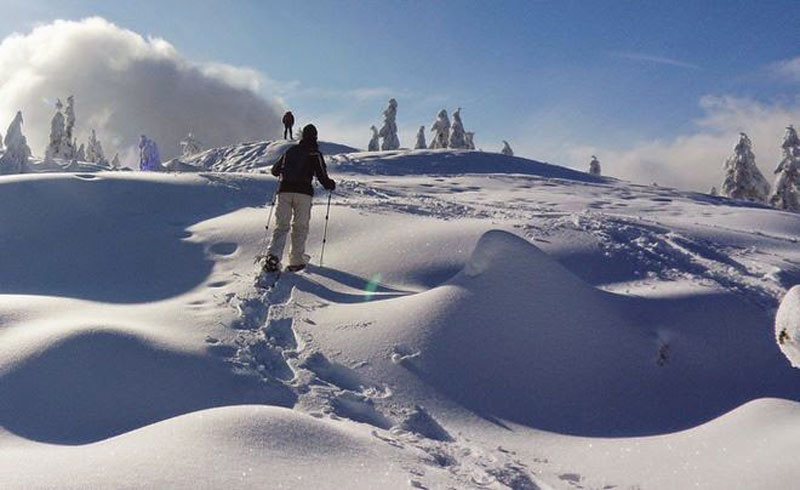
HOW-TO-TURN-TREKKING-POLES-INTO-SNOWSHOE-POLES

Time for a winter upgrade. Photo: Jennifer C./Flickr

There’s no question that a good pair of poles is a boon for staying on your feet and balanced while out snowshoeing, especially if you’re tromping around in uneven terrain or snow conditions. But what exactly is the difference between a pair of trekking poles and those marketed as “snowshoe” poles?

Not much. They are essentially identical, with only three minor differences to consider. In order of importance, they are:

Snow Baskets

Trekking poles typically come with a small basket an inch or two above the tip, which helps prevent them from sinking too deeply in mud or other loose conditions underfoot. Snow, on the other hand, is much deeper and much more loosely consolidated. In order to gain purchase, and not sink to the bottom of the snowpack, you need much larger diameter snow baskets. “Snowshoe” poles always come equipped with these. Trekking poles typically do not. However, every brand out there gives you the ability to swap out the trekking baskets for snow baskets, which are usually sold as a $5 – $15 accessory.

Length

In most snowshoeing conditions, the pole tip will sink to some extent into the snow and gain purchase at a deeper point underfoot than if you were walking on solid ground. Therefore, poles for snowshoeing should be set at a longer length than trekking. (For a primer on trekking pole adjustment, see Sticks and Stones: The Pros, Cons, and Uses of Trekking Poles). This is only a concern if you’re tall and/or use a pair of shorter trekking poles (lightweight poles and ones marketed for women are usually shorter by several inches).

Shock Absorbers

This has always struck me as the most overblown benefit/feature of trekking poles. If you believe the hype, the spring-like recoil featured in many trekking poles reduces compressive forces on your hands, wrist, and upper body while going downhill. (I’m skeptical of the claim based on my own experience and have never seen any research to back this up. Plus, the on/off aspect of this feature has consistently been one of the most common issues of poles I’ve used. But I digress…) Shock absorbers provide no benefit on the loose structure of snow. “Snowshoe” poles never feature them, which also helps keep their cost lower ($50 – $80) than many styles of trekking poles ($50 – $200+).

So the upshot is this: Snowshoe poles are trekking poles. Trekking poles are snowshoe poles.


Share this post:
  • Facebook
  • Pinterest
  • Twitter
  • Linkedin
  • RSS
AMC logo

10 City Square
Boston, MA 02129

  • Destinations
  • Get Involved
  • Resources
  • Conservation
  • Community
  • Careers
  • AMC Press Room
  • Email Signup
  • Log In to MyOutdoors
Weather and Trail Conditions Weather & Trail Conditions Book Now Book Now Support Support the Outdoors Shop Shop Contact Us Contact Us Help Center AMC Help Center About AMC About AMC AMC Business AMC Business
Guide Star
One Percent for the Planet
Charity Navigator

instagram
facebook
youtube
bluesky
tiktok

Policies Terms of Use Web Accessibility Site Map

The Appalachian Mountain Club is a nonprofit, tax-exempt charitable organization (tax identification number 04-6001677) under Section 501(c)(3) of the U.S. Internal Revenue Code. AMC operates under several special permits and leases, including in the White Mountain National Forest, New York Palisades Interstate Park Commission, and New Hampshire State Parks.

Copyright © 2024, Appalachian Mountain Club