


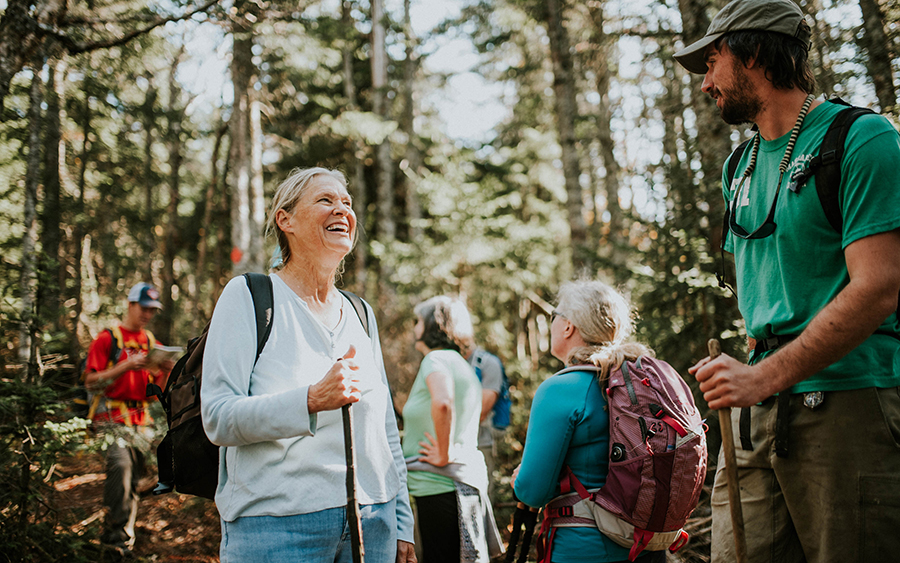
Want to keep hiking at any age? The answer is partly attitude, but there are some preventative steps you can take to help you stay fit.
Vigorous hikers in their mid- to late-60s are as abundant as black flies on New Hampshire’s Cohos Trail in June, while hikers in their 80s can be rare enough to draw (usually unwanted) attention. Each person ages differently, with the possibility of accidents and illness affecting anyone at any time. So what, exactly, can mature outdoor addicts do to keep hiking as long as possible? Below are a few helpful tips to keep you active into your 70s, 80s, and beyond.
Attitude
If you think you’re too old, you’ve already lost the battle. Or you could emulate Jean Williamson, 87, of Wilmington, Mass., who completed New Hampshire’s 48 4,000-footers at age 73. “I’m just an ordinary person, and I accept that I’m going to hike slower and maybe not go as far,” she says. “But my attitude is always: It’s going to be a good day. Let’s go hiking.”
Persistence
The best way to keep hiking is to keep hiking. “I’d hike every day if I could, but on days that I can’t, I go to the gym,” Williamson says. Cross training also works for Tom Sawyer, 73, who plans to complete New Hampshire’s so-called “48 over 70” this summer. “I walk every day, stretch, rock climb, do yoga, and strength train, but the best training for hiking is hiking,” he says. “The more you do, the more you can do.”
Balance
Falling or fear of falling ends too many hiking careers. Yoga and tai chi help. Most older hikers use trekking poles, but there’s more to it than that. Paul Richelson, a certified pedorthist at Feet First in Plymouth, N.H., reminded me (age 68, for the record) at my last fitting that feet typically get longer and wider, and ankle ligaments stretch as we age.
Changes in the way boots fit can affect foot comfort, ankle stability, knees, hips, and back, all of which lead to balance issues.
Failing eyesight, too, can impact balance. Eliot Foley, an ophthalmologist with New Hampshire’s Concord Eyecare, says cataracts, macular degeneration, glaucoma, and even something as simple as bifocals can all bear on your hiking. “Vision is part of your whole balance system,” Foley says. “The better you can see your feet and the trail, the more confidently you can hike.”
Consultation
Listen to your body but know when to ask an expert. Sometimes an ache or pain could be due to an extra 5 pounds. As Marilyn B. Donnelly, a registered dietician with Concord Regional Health Care in Concord, N.H., says: “Every extra pound impacts your feet, knees, and hips. Weight control is 80 percent diet, 20 percent exercise.”
But sometimes what your body is telling you is simply wrong. “I had knee pain for several years and wore a brace,” Williamson says. “Then I saw a doctor, had a hip replaced, and my knee pain went away.”
There’s no cure for aging, but by taking care of each problem as it arises, you could extend your hiking horizon by years, if not decades.