• Skip to main content
  • Skip to footer

Appalachian Mountain Club (AMC)

Weather Become a Member Booking Book a Stay How to Treat Cuts & Wounds on the Trail Donate Shop Shop Contact Contact Us
Search
  • Destinations
    • Maine
      • Medawisla Lodge & Cabins
      • Gorman Chairback Lodge & Cabins
      • Little Lyford Lodge & Cabins
      • Moose Point Cabin
      • Mountain Brook Cabin
      • Knubble Bay Camp
      • Beal Island Campground
      • Echo Lake Camp
    • Massachusetts & Connecticut
    • New Hampshire
    • High Mountain Huts
    • New Jersey & New York
    • Western US
    • Group Reservations
  • Adventures
    • Adults
    • Women’s+
    • Teens
    • School Groups
    • Guided Trips
    • Adventure Travel Worldwide
  • Get Involved
    • Become a Member
    • Renew Your Membership
    • Become a Volunteer
    • Donate
    • Support Your Trails
  • Community
    • Chapters
    • Major Events
    • Local Outings
    • Outdoor Skills & Leadership Trainings
    • Outdoor Journey Fund
  • Conservation
    • Our Priorities
    • Our Approach to Conservation
    • Maine Woods Initiative
    • How You Can Help
    • Trails & Recreation Management
    • StoryMaps
  • Resources
    • AMC Outdoors Blog
    • Bucket List Trips
    • Books & Maps
    • Appalachia Journal
    • Library & Archives
    • Weather & Trail Conditions
    • FAQs
  • About Us
    • Leadership & Financials
    • All Out: AMC Action Plan 2025-2030
    • A Welcoming Community
    • Careers
    • Brand Partners
    • Contact Us

Support the Outdoors

Other Ways to Give

  • Membership
  • Volunteer
  • Legacy Giving
  • Memorial and Honorary Gifts
  • Special Initiatives
  • Corporate Sponsorship
  • President’s Society
Close support popup

How to Treat Cuts & Wounds on the Trail

By AMC Staff,

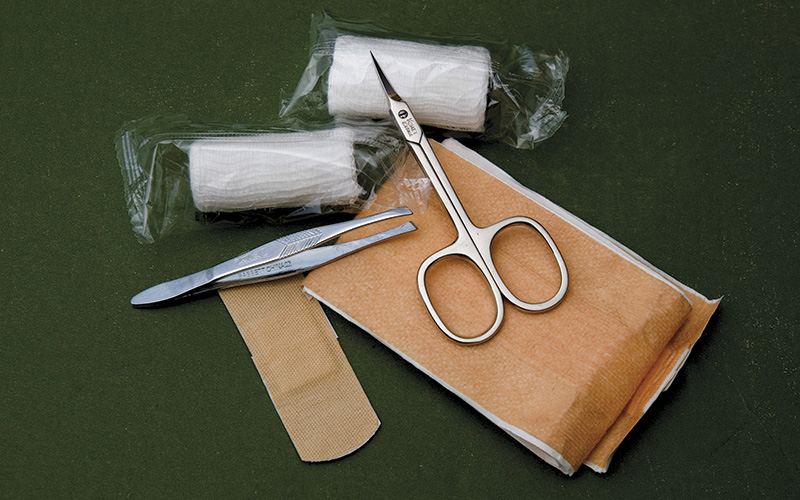
tools to treat cuts

Carrying the right tools is step 1 when it comes to how to treat cuts and wounds while hiking.


We’ve all been there: You’re opening a can of baked beans when—bam—you cut your finger. Fortunately, a good backcountry first-aid kit comes stocked with the necessary supplies to treat a small cut or abrasion: adhesive bandages, occlusive dressing, gauze, adhesive tape, antibiotic ointment or petroleum jelly, tweezers, a syringe, and nonlatex gloves.

By knowing how to use these essentials, you can properly treat a cut or a scrape. It’s important to take all soft-tissue injuries seriously due to the potential risk of infection: Even a small, seemingly harmless wound can snowball into a larger issue that might warrant an unplanned trip to the hospital. For immediate treatment, when professional care is more than 24 hours away, follow these steps:

  1. No matter if you are treating yourself or someone else, it’s best to wear nonlatex gloves throughout the procedure.
  2. To control bleeding, apply direct pressure on the wound using a gauze pad or a clean bandana. Elevate the wound and monitor it for 20 to 30 minutes.
  3. Once bleeding has stopped, remove any foreign material in the wound (e.g., sand, grass, etc.) with a pair of sterilized tweezers.
  4. Use a syringe filled with potable water to pressure-wash and clean the wound. If a syringe isn’t available, you can force water out of a hydration pack by holding the bladder at shoulder height or higher then pinching the mouthpiece attached to the end of the hose.
  5. Dry the wound with sterile gauze. Keep the wound moist with petroleum jelly or antibiotic ointment then covering with more sterile gauze or adhesive dressing. (Recent studies have shown that wounds kept moist have a greater chance of fighting infection than wounds kept dry.)
  6. Bandage the dressing in place with adhesive tape and occlusive dressing, checking the wound 30 minutes later and redressing if necessary.
  7. Change the dressing at least every 12 hours. Depending on the severity of the cut, the dressing might need to be replaced more often. Make sure the wound remains moist and monitor for signs of infection.
  8. Check circulation, sensation, and motion (CSM) of body parts located far from the injury. If CSMs are impaired, splint the injured body part and evacuate the patient.


Share this post:
  • Facebook
  • Pinterest
  • Twitter
  • Linkedin
  • RSS
AMC logo

10 City Square
Boston, MA 02129

  • Destinations
  • Get Involved
  • Resources
  • Conservation
  • Community
  • Careers
  • AMC Press Room
  • Email Signup
  • Log In to MyOutdoors
Weather and Trail Conditions Weather & Trail Conditions Book Now Book Now Support Support the Outdoors Shop Shop Contact Us Contact Us Help Center AMC Help Center About AMC About AMC AMC Business AMC Business
Guide Star
One Percent for the Planet
Charity Navigator

instagram
facebook
youtube
bluesky
tiktok

Policies Terms of Use Web Accessibility Site Map

The Appalachian Mountain Club is a nonprofit, tax-exempt charitable organization (tax identification number 04-6001677) under Section 501(c)(3) of the U.S. Internal Revenue Code. AMC operates under several special permits and leases, including in the White Mountain National Forest, New York Palisades Interstate Park Commission, and New Hampshire State Parks.

Copyright © 2024, Appalachian Mountain Club